Summary: The Evolving Role of Universities in the American Innovation Ecosystem
Spring 2022 Conference | March 3–4, 2022 | Online
Presented by The Center for Innovation Policy at Duke Law in collaboration with Duke Law’s Center on Law, Ethics and National Security, Duke University’s Office of Research & Innovation, and Duke University’s Innovation & Entrepreneurship Initiative.
Download the complete Summary:
Executive Summary
- Universities remain a vital component of the American innovation ecosystem, providing talent, expertise, new knowledge, global connections, and a platform for entrepreneurial activities.
- International connectivity continues to be a critical part of university research advancement as well as talent recruitment. Bringing students and scholars to the U.S. has benefits for U.S. innovation and for the world that exceed their costs. However, growing competitiveness and national security concerns create substantial challenges. These concerns must be balanced against the significant benefits of global engagement. Policymakers should also distinguish between national security breaches and IP theft, on the one hand, and universities’ negligent failure to report fully international contacts on the other.
- University-industry collaboration remains an integral part of the U.S. innovation system. Such collaboration will likely increase in importance, especially if federal government funding for research stagnates and as pressures on universities to spur regional economic development increase.
- For universities to continue to play a productive role across the innovation landscape, they must have ready access to ample funding and related support. Industry funding is not a substitute for public funding. University leaders are concerned that funding for critical research will remain inadequate without a new level of commitment by the federal government.
- Universities may need to re-envision their operations to allow a more diverse array of students to have access to a broader array of educational resources in scientific and technological fields.
Welcome and Introduction
ARTI RAI, Duke Law School
The conference started with a series of observations offered by Professor Arti Rai, who also serves as Faculty Co-Director of The Center for Innovation Policy at Duke Law. Rai highlighted the centrality of universities in the structure and operation of the U.S. innovation system. According to Rai, there have been three distinct eras in the post-World War II development of the American research ecosystem: 1) the Cold War era, distinguished by high levels of government funding to support defense-related research; 2) the era of the Bayh-Dole Act, which was focused on the commercialization of federally funded R&D by universities; and, 3) the current era, which continues the focus on commercialization, but with additional themes related to competitiveness and security.
Rai next observed that, going forward, U.S. universities’ global leadership in research would depend in significant part on addressing three core issues: 1) scholarly immigration and the sustainability of the talent pipeline; 2) finding an appropriate balance between the benefits of increased internationalization and protecting U.S. national security interests; and, 3) creating a tighter, more collaborative relationship between industry and universities, especially in light of substantial fluctuation in federal support of universities (see figure below).
Higher education R&D expenditures, by source of funds: FYs 1972–2020

Note(s): Because of rounding, detail may not add to the total. Includes all institutions surveyed in the fiscal year shown. Prior to FY 2003, totals did not include R&D expenditures in non-science and engineering fields. Other sources includes R&D expenditures funded from state and local governments, businesses, nonprofit organizations, foreign governments, foreign or U.S. universities, and gifts designated by the donors for research.
Source: National Center for Science and Engineering Statistics, Higher Education Research and Development Survey.
Keynote Address
Dr. Michael Crow
President, Arizona State University
Professor Rai’s introductory remarks were followed by a provocative keynote speech by Dr. Michael Crow, President of Arizona State University. President Crow began by drawing attention to the new landscape for universities that had been identified in Rai’s comments. While Crow acknowledged that not all universities will look alike or share the same priorities, he emphasized that in view of the competitiveness and talent issues faced by the United States, universities need to become more inclusive (rather than highly exclusive), to better position themselves to contribute economically and socially as well as academically, and to redesign themselves to become more responsible for outcomes outside their physical campuses. Crow particularly stressed that universities must step forward in becoming more accountable for the economic success of their regions as well as the country. He suggested that one way to do this is to reconceptualize the university in terms of scale; another way is to find new points of alignment and cooperation with government, industry, and other kinds of organizations—domestic and international. He offered as an example the alliance between Arizona State University and the Mayo Clinic that is part of an effort to create an innovative campus around the future of healthcare.
–Dr. Michael Crow, President, A.S.U.
Crow went on to emphasize that universities must become more adept at breakout thinking such as how to launch new research endeavors that are beyond the traditional scope of government support. He argued that this requires a reconfiguration of the research enterprise, including a broadening of the teams of people that are engaged in collaboration. According to Crow, universities must remain committed to curiosity-driven research, but they also must give greater weight to outcomes-oriented research. In his view, the accelerated technological change brought on by the new digital economy has made change by universities even more imperative. As another example of a shift, Crow suggested universities build more intimate cooperative engagements with companies—becoming partners for companies that are looking to sustain themselves amid the constant change.
Crow offered engineering education as a specific area where universities could bring about meaningful change. He framed the issue in part around how universities can obtain the benefits of greater scale so that they can produce more high-quality graduates. Instead of continuing to focus on traditional engineering education, Crow suggested that engineering students can benefit from a new focus on how engineering can address the grand challenges defined by the National Academy of Engineering. This involves orchestrating a number of cross-border partnerships so that promising ideas can be captured and applied wherever they can get traction. He argued that the era of single, dominant hubs in any one technology is giving way to more diffuse capabilities across the globe. More broadly, Crow suggested that the existing approach to curriculum and teaching across all fields has become stale and that we need a revitalization that gives students the benefit of familiarity with several disciplines to prepare them for living and working in the 21st century.
During the Q&A period moderated by Dr. Denis Simon, Executive Director of The Center for Innovation Policy at Duke Law, President Crow extended his remarks in a number of key areas. Emphasizing the fact that global competition is fully upon us and is accelerating all the time, Crow suggested that we cannot afford to be complacent. Referring to the need for new tactics, new strategies, and new ways of doing things, Crow once again came back to the issue of scale and why it remains so central to America’s technological future, adding that attaining new levels of scale across multiple dimensions is the key to enhancing American universities and U.S. innovative performance.
President Crow also argued that universities need to: 1) fortify the ranks of the U.S. talent pool by continuing to open the door to international students and giving them the opportunity to remain in the U.S. upon graduation; 2) broaden the community of engineers to a much broader group of individuals ethnically, socio-economically, culturally, and creatively; 3) reach out to the K–12 community of schools and students using digital technologies to create learning partnerships that can support the talent pipeline; 4) build more vibrant relationships with community colleges that reflect the importance of these institutions in the overall education effort; 5) get beyond being simply “administered” by professional bureaucrats and instead be led by innovative thinkers and doers; 6) broaden the way we educate our students so that they can take on the complex challenges facing society and the world; 7) consider more emphasis on micro-credentialing in order to better highlight individual skill areas; 8) better harness technology to make possible some of the “out-of-the-box” thinking about how to advance education and learning; 9) learn from our COVID experiences, including the fact that universities could and should work together more often and more consistently; and, 10) allow for more differentiation so that the cookie cutter approach gives way to more tolerance and flexibility about what makes for a successful academic institution. Crow closed his comments by suggesting one substantial change that he thought would make a major difference going forward: that the most highly-selective institutions in the U.S. begin talking more broadly about how higher education needs to reform to meet national needs, rather than protecting and defending their established position.
Panel 1:
The Future of the University in the U.S. Research and Innovation Ecosystem
REBECCA BLANK, Chancellor, University of Wisconsin-Madison
SHIRLEY ANN JACKSON, President, Rensselaer Polytechnic Institute
FARNAM JAHANIAN, President, Carnegie Mellon University
VINCENT PRICE, President, Duke University
Moderator KERRY ABRAMS, Dean, Duke Law School
The four university presidents (Rebecca Blank, Shirley Ann Jackson, Farnam Jahanian, and Vincent Price) focused on the following themes: 1) collaboration with industry research funders, among universities, and across disciplines, particularly in light of a challenging federal funding environment; 2) establishing an infrastructure for commercialization of university research; 3) whether, and how, university research could promote national and social values; and, 4) university contributions to a more widely distributed geography and demography of innovation.
–Dr. Rebecca Blank, Chancellor, U. Wisc.-Madison
All the presidents observed that the decline in federal funding for R&D (as Shirley Ann Jackson emphasized, from 11.7% of the federal budget in the mid-1960s to less than 3% today) had prompted universities to look for other sources of funding, including industry and other private sector sources. Rebecca Blank noted, for example, that long term research partnerships with “old, big” companies in sectors such as the automotive industry or health care could be fruitful. As for startups, Blank endorsed her university’s move away from a traditional patenting and licensing model towards a model in which, like a venture capitalist, the university took equity in a new startup. Jackson discussed industry support and constrained resources as a catalyst for universities to work together. Picking up on this theme, Vincent Price endorsed cross-university and regional collaboration but lamented that such collaboration across universities might sometimes be impeded by exaggerated antitrust concerns.
–Dr. Vincent Price, President, Duke Univ.
The presidents also discussed challenges that arose in the execution of industry-university collaborations, including disputes over intellectual property, universities being asked to shoulder a disproportionate share of the costs of doing upstream research, and disputes regarding publication, particularly with respect to graduate student publication. Jackson also noted that non-federal funding did not always include support for graduate students. All the presidents emphasized the need for collaboration across disciplines, with Farnam Jahanian particularly emphasizing the ways in which revolutions in the power of computing and data had led to a convergence across disciplines.
Blank emphasized the importance, and difficulty, of setting up the appropriate infrastructure for commercialization of research generated at universities. She observed that faculty were not always trained in the value of doing translational research and also that faculty didn’t necessarily have the skill set for commercialization-oriented tasks.
–Dr. Farnam Jahanian, President, C.M.U.
Jahanian emphasized his view that one step towards setting up such an infrastructure was rejecting the “false choice” between use-inspired research and curiosity-inspired research. More generally, all the presidents echoed President Crow’s keynote in endorsing a tight connection between university research and larger national and social values. National values mentioned by the presidents included global competitiveness, national security, and supply chain stability. Social values included combating climate change and promoting public health. Price particularly emphasized the importance of humanistic values taught by universities in shaping science but observed that like many other institutions, the university had become politicized and that the public didn’t necessarily understand its role. Blank noted that a “social value screen” for university research could be ambiguous.
–Dr. Shirley Ann Jackson, President, R.P.I.
Jackson and Jahanian stressed the role that universities could play in expanding the geographic and demographic profile of innovation. With respect to undue geographic concentration, Jackson mentioned the role of the “three-legged stool” of government, industry, and universities in promoting advanced manufacturing in many different geographic locations. Picking up on the advanced manufacturing theme, Jahanian thought digital tools might be particularly helpful in “democratizing” such manufacturing. Jahanian also mentioned a Brookings study finding that 90% of technology-related job growth in recent years had occurred in only 5 geographic areas. He viewed the role of Carnegie Mellon and other universities in bucking this trend and contributing to what he termed the “renaissance of Pittsburgh” as the result of a very intentional strategy.
Jackson stressed the importance of human capital to innovation, and the need for universities to engage in broad outreach, perhaps especially to women and minorities, to develop such capital. She and the other presidents also insisted that U.S. universities must not simply remain open to, but must do everything they could to attract, the global talent pool.
Panel 2:
Immigration Policy and the Availability and Cultivation of Talent to Support U.S. Universities’ Missions
DANY BAHAR, Watson Institute for International & Public Affairs (Brown University)
ESTHER BRIMMER, NAFSA: Association of International Educators
RICHARD FREEMAN, Harvard University and NBER
CAROLINE WAGNER, The Ohio State University
Moderator STUART BENJAMIN, Duke Law School
The panelists’ remarks centered on three related themes: 1) the benefits both to the United States and the countries of origin of immigration of students and scholars to U.S. universities; 2) the benefits of such immigration to U.S. universities more specifically; and, 3) the importance of in-person interactions for building research relationships and providing for the spread of tacit knowledge.
Number of international students in the U.S., 1980–present

Source: International Student and U.S. Higher Education Enrollment, 1948/49–2020/21; Open Doors Report on International Educational Exchange. Retrieved from https://opendoorsdata.org/.
All four panelists presented data on the benefits to the U.S. of international students and scholars coming to the U.S. and working in U.S. universities. Esther Brimmer presented data on the contributions of international students and their families to the U.S. economy and the benefits to U.S. students of the interactions with foreign students. She added that bringing in international students helps the U.S. to compete globally. Caroline Wagner also suggested that bringing in international students helps the U.S. compete globally. She said that in 1980 seven nations produced 90% of the world’s research and development, but that now about 25 nations combine to reach that 90% figure. She said that this highlights that the spectrum of contributors has greatly expanded and that no nation goes it alone. She added that the open exchange of views and knowledge in the U.S. has enriched the U.S. research enterprise and magnified the benefits to the U.S.
–Dr. Esther Brimmer, NAFSA: Association of
International Educators
Dany Bahar and Richard Freeman presented data on connections among researchers. Bahar used the example of a particular inventor who studied in the U.S. and then returned to Chile, building in Chile on the research—and research relationships—that they had developed in the U.S. Bahar referred to such researchers as global mobile inventors. He argued that global mobile inventors’ experience in the U.S. pays huge dividends to the U.S. and the world when they make connections and create inventions with researchers in other countries. Freeman presented data on COVID-19 vaccines, finding that most vaccine company leaders had non-U.S. backgrounds but were educated in U.S. universities. He also found that all clinical trial research papers had authors who had had a U.S. university address, and that almost half of U.S. university-linked authors had a non-U.S. background. He thus concluded that U.S. universities employ many authors on the clinical trial papers and educate many inventors on patents, and more generally that international students and scholars are key to the U.S. innovation system.
–Prof. Caroline Wagner, The Ohio State University
With respect to the benefits of foreign students and scholars to U.S. universities, Brimmer emphasized the high percentage of international students who earn masters and PhD degrees in U.S. universities, and the benefits to U.S. universities of that infusion of international talent. She noted that international students constitute about 5% of the total student population but nearly half of masters and PhD degrees awarded in STEM fields. Wagner discussed the ways that international researchers join research networks with domestic researchers, to the benefit of those researchers and U.S. universities (as well as the U.S. more generally). Freeman agreed, emphasizing that U.S. universities rely greatly on international talent. And all speakers emphasized the benefits to U.S. universities of the collaboration that occurs among domestic and international researchers. They argued that such collaboration is vital to U.S. universities and the research enterprise.
The speakers also noted the flip side to the points above—the costs to U.S. universities, and the U.S. more generally, of restrictions on immigration of foreign students and scholars. The speakers, and Brimmer in particular, suggested that in light of the important role that such immigrants play for U.S. universities, restrictions on immigration deprive universities of talented people who help spur research and increase net social welfare.
One obvious question is the extent to which in-person interactions enhance the value of collaboration between domestic and international students and scholars. Bahar presented evidence suggesting that in-person interactions seem to be more valuable than virtual interactions. He stated that a relatively small number of global mobile inventors work in the U.S. and other countries and have a huge impact on global innovation. As a way of measuring the benefits of hiring foreign researchers, he found that actions limiting immigration reduced innovation output, and that the value of Fortune 500 companies dropped approximately $100 billion when the U.S. executive order banning visas for foreign workers was announced (see figure below). All four panelists emphasized the importance of in-person interactions for transmitting tacit knowledge that enhances research productivity. Wagner noted a survey she did at the RAND Corporation found that 90% of international collaborations began face-to-face.
In response to a question about the effects on the countries that send their students and scholars to the U.S., all four stated that not only does the world generally benefit from the resulting collaboration, but also that the sending country benefits as well. All the panelists stated that some of those international students and scholars help to boost research both in their home countries and in the U.S. because of the international research collaborations that they are part of. Bahar’s emphasis on global mobile inventors underscored this point, as those inventors often return to their home countries and spur additional invention there. Bahar also noted a paper by Gaurav Khanna finding that the H1B visa lottery motivates Indians in India to become engineers—a brain gain rather than a brain drain. More generally, the panelists suggested that U.S. universities bringing in foreign students and scholars help the sending countries by enriching those countries’ research environments.
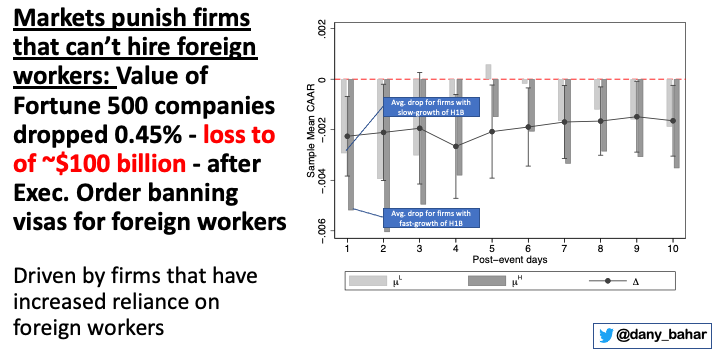
Source: Bahar, Choudhury and Glennon, mimeo
The panelists were thus in agreement that U.S. universities’ openness to foreign students and scholars has benefits that exceed the costs for U.S. universities, the U.S. more generally, and the world. And they do not believe that the benefits would be as great without the face-to-face interactions that physical presence at universities affords.
Panel 3:
National Security and the Integrity of the Research Enterprise at U.S. Universities
DAVID FLESHLER, Case Western University
DAVID HOFFMAN, Duke University
REBECCA KEISER, National Science Foundation
DAVID KRIS, Culper Partners
Moderator DENIS SIMON, Duke University
In the world of American universities, national security matters have now become a critical public policy issue for university administrators as well as policymakers. Starting in the 1980s when universities began to focus on campus internationalization and expanded cross-border collaboration, the mantra among U.S. institutions of higher education has been built around global engagement. Today, however, as concerns about the economic rise and technological advance of countries such as China have grown, new questions have been raised about how to accommodate both threats to national security and the benefits of international collaboration and cooperation. This panel on national security and universities took on the challenge of identifying the growing source of the problems along with defining workable solutions to guide the next generation of cross-border cooperative activities by U.S. universities.
David Fleshler noted that Russia’s invasion of Ukraine exacerbated tensions between national security concerns and international engagement that were already extraordinarily complex. The invasion not only created havoc inside Ukraine but also had a major impact on international students studying in that country. Moreover, because of the subsequent embargo and related actions adopted by Western countries towards Russia, many academic exchanges and research cooperation efforts were shut down completely.
–David Fleshler, Case Western Univ.
The panelists stated that the continued impact of the COVID pandemic cannot be forgotten as we consider the future direction of international exchanges. David Hoffman suggested that while the expanded deployment of technology enabled many higher education institutions to continue academic programming during the COVID pandemic, it also soon became clear that the greater reliance on technology may have created new areas of possible exposure and vulnerability as hackers have the capability to violate the security of classroom meetings carried out online as well as Zoom-type conferences and seminars that are invitation only. He added that a new type of security problem has emerged that could lead to greater student and faculty self-censorship among other problems.
The panelists indicated that the new national security imperatives that are reshaping the internationalization activities of universities implicate three main issue areas: 1) access to talent and the treatment of both domestic and international scientists and engineers; 2) the nature of research collaboration, including the management of intellectual property/know-how that could have dual use applications; and, 3) risk mitigation strategies and controls that need to be adopted to reduce threats without damaging beneficial cross-border cooperation. The four panelists indicated that all three areas need to be treated as part of a larger package of instruments from government, business, and the higher education sector that capture potential synergies and reduce the points of friction going forward.
–David Kris, Culper Partners
Taking the talent issue first, questions surrounding the former “China Initiative” seemed to attract the most attention throughout the panel discussion (see chart below). On the one hand, according to David Kris, many universities have simply been naïve in terms of the types of threats they face because of globalization and the open, transparent nature of the research environment inside most U.S. universities. On the other hand, Fleshler suggested that given the global nature of the many problems facing the world such as climate change, the need for clean energy, and transnational pandemics, there is little doubt that a truly multi-country collaborative effort is needed to address these pressing problems and to develop workable solutions for the future betterment of humankind. According to Rebecca Keiser, preserving the integrity of the American research enterprise, especially inside the university sector, is one paramount goal; the future of American economic prosperity and technological leadership depends on maintaining an open system where information can and should flow freely. That said, as Kris pointed out, not every country or individual plays by the same rules and there are those who would take advantage of the openness of the American system. Accordingly, Keiser suggested that it is incumbent on universities and government to develop a series of compliance mechanisms that can give confidence to those focused on national security matters that institutions of higher education are indeed screening new visitors and monitoring existing ones to ensure that their activities are consistent with their reasons for coming to the U.S.
Cases charged under the China Initiative by year
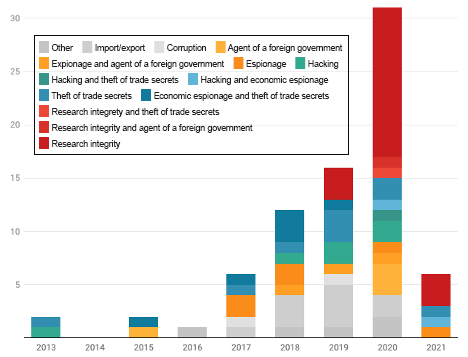
Chart: Jess Aloe and Eileen Guo Source: MIT Technology Review, Dec. 2, 2021
While supporting the basic purpose of the China Initiative, which was launched to crack down on individuals who allegedly were engaged in behaviors inconsistent with U.S. national security interests, Kris noted that it turned out to be too heavy handed, misdirected in most cases, and lacking in a complete understanding of the world of academic research. Fleshler suggested that the failure of the Department of Justice to successfully prosecute a sizable number of the cases that had generated extensive media attention indicates that something was not right in the way the initiative was conducted. He added that the decision to focus on those persons who were part of China’s 1000 Talent Program as well as related PRC talent initiatives also proved beset with problems in the final analysis. Both Kris and Keiser said that while China’s talent programs do present a number of serious national security challenges, especially in terms of their recruiting practices and the reward system that they offer, an amnesty-driven program might ultimately have yielded more pertinent information. Among the individuals singled out by the Department of Justice, the bulk may have been guilty of tax fraud or violation of employment contracts, but not industrial espionage. The panelists agreed that the recent decision to terminate the China Initiative has generally been well-received. Kris’s comments indicated that what is needed to address these types of cases is more of a scalpel than a sledgehammer.
The second set of issues revolves around the nature and thrust of research collaboration and the ability to identify knowledge that requires additional layers of review before being shared. Keiser suggested that this might be a suitable time to put in place a new type of catechism to help manage international research collaboration. She added that it may also be time to draw a new road map for cross-border collaboration that reflects the evolving changes in capabilities between selected countries such as the U.S. and China. She further noted that fundamental research, which was once easily identified in the context of potential applications, is now more difficult to address because in a number of cases there has been a direct link between this type of research and applications used for nefarious purposes, such as facial recognition and video surveillance technologies used against racial minorities. All the panelists agreed that the most productive way ahead must include greater clarity and transparency about the know-how being developed, the partners involved, the intended applications (if any), and the terms of engagement.
A related concern that the panelists identified is the growing fears surrounding excessive foreign influence on U.S. universities resulting from expanded reliance on foreign sources of research funding. Fleshler noted that a number of top tier U.S. research universities have been queried by the U.S. Department of Education because of monies they received to support research activities in the U.S. (Section 117 investigations). While most universities were aware of their responsibility to report such funding sources, the regulations were largely dormant for many years as the levels of international engagement sharply increased. Fleshler said that the unanticipated effort to enforce these regulations that occurred under the Trump administration has had a huge chilling effect on many U.S. campuses as university leaders feared the consequences of non-compliance—past and present. He added that many American universities have now put in place stronger compliance procedures and reporting mechanisms to avoid damaging their standing in terms of future federal funding.
The third issue area involves strategies for risk mitigation and management. Based on the perspectives offered by all four panelists, there does not seem to be any appetite for curtailing the global engagement of universities, as international cooperation and education exchanges are understood to be key elements for enhancing the vibrancy of the American research system. That said, Kris and Hoffman observed that universities, whether they intend it or not, are involved in matters that include supporting national competitiveness as well as promoting and protecting national security. Keiser commented that the new directorate being created at the National Science Foundation is focused on technological innovation and partnerships; the technology in question involves so-called “use-inspired research.” A thorough review process is being installed to ensure that collaborative endeavors do not ignore potential risks. Keiser said that the idea of instituting a tight review process is consistent with the notion that with government funding comes an important responsibility for full transparency and disclosure. She added that a self-reporting approach should provide better disclosure than an effort to uncover some type of malfeasance where it does not necessarily exist. Fleshler stated that strengthening public-private partnerships is another avenue that is re-emerging as a reasonable means to counter egregious attempts to violate the integrity of U.S. research institutions. Finally, several panelists discussed the idea of creating some type of multinational consortium that defines the rules of the road for future research collaboration. They suggested that there are some good reasons to develop such a consortium as a non-government organization with universities taking the lead role in managing their collective activities. Several of the panelists agreed that this need for effective but efficient oversight may provide good opportunities for organizations such as AAU, APLU, ACE and AIEA to play a more active, significant role in defining potential minefields and related problems.
Panel 4:
The Role of University-Industry Relationships in Universities’ Research Missions
MARYANN FELDMAN, The University of North Carolina at Chapel Hill
KARL KOSTER, Massachusetts Institute of Technology
DAVID REESE, AMGEN Inc.
SANDY WILLIAMS, Duke University
Moderator ARTI RAI, Duke Law School
All the panelists agreed that corporate-university relations are evolving rapidly and that this evolution is quite important in light of the continuing decline (particularly outside the life sciences) in the percentage of university research that is federally funded.1 Speakers noted the increased importance to universities of industry funding not only from large corporate actors but also from venture capital.
Against this background, speakers discussed the following interrelated themes: 1) challenges in managing complex industry-university contracting, including with respect to intellectual property; 2) reorganization of the administrative structure that manages university-industry contracting; 3) the respective roles of university-generated startups, venture capital, and established firms; and, 4) whether current trends will achieve the ultimate goal of widely-distributed, long-term prosperity through innovation. Threaded through all the discussions were proposals for changes in federal law and policy, including policies governing federal funding programs, technology transfer by academic institutions, and tax policy.
All the panelists thought that the complexity of university-industry interactions had increased. David Reese discussed working with universities in contexts where the transaction in question involved not an individual intellectual property license but rather a “basket of assets in a disease area” on which both basic and more applied research could be performed. In his view, the merger of data science, particularly machine learning, with the life sciences is creating a “hinge moment” for such complex contracting with universities. As he noted, collaborations with universities that have medical systems have the added benefit of potentially providing industry access to valuable data in the form of electronic health records.
–Dr. Sandy Williams, Duke Univ.
Part of the contracting complexity emerges from sometimes divergent university and industry expectations on intellectual property. David Reese, Karl Koster, and Sandy Williams all suggested that each side of the university-industry divide tends to overvalue its intellectual property contribution. Williams also noted that continued focus by technology transfer offices on “short term licensing revenue rather than value creation” tended to impede entrepreneurship and partnerships with industry. In the context of a larger point about university technology transfer as an “unfunded mandate” that might lead to focus on short-term revenue, Maryann Feldman stressed the particular resource problems faced by technology transfer offices in states with the greatest economic needs.
As a potential intervention for streamlining contracting, including with respect to IP, Reese and Koster suggested master contracts. Koster noted that MIT has also set up a variety of different teams devoted to streamlining IP and other contractual issues in both smaller collaborations between an individual investigator and an industry sponsor and in larger, multi-investigator, multimillion dollar collaborations. Williams observed that one legal reform that would facilitate university-industry contracting is tax code revisions that would, in his view, create space for universities to collaborate without losing their tax-exempt status.
According to Koster, MIT’s recognition of the increased role played by corporate funding prompted it, at least in part, to reorganize its internal administrative structure. At MIT, all corporate-facing activities, whether contracting associated with receipt of corporate research funding or collaborations that arise from commercial application of university research initially funded by the federal government, are now housed in one office. Included within this office are the previously mentioned teams that help to craft IP and other contract terms with industry. Meanwhile, research funding from federal sources is now handled by a separate office.
The idea is that contracting with the private sector, whether on the inbound or outbound side, requires similar personnel traits, and these similarities do not overlap with the skill set most useful for contracting with the public sector. Williams noted that Duke has adopted a broadly similar approach to reorganization. For his part, Reese applauded the approach, noting the virtues for a private sector firm of dealing with only one office for all questions that involve contracting over knowledge.
–Prof. Maryann Feldman, U.N.C.
All the panelists noted the distinctive, and important, roles played by university-generated startups, venture capital, and large corporate firms. Williams argued, however, that sometimes faculty members spin out firms too early. Reese stated that large firms like his could provide useful advice to nascent university startups, including advice on how to “get to the next level” so that a firm like Amgen might be interested in partnership. Koster similarly thought that “large corporations,” including their venture arms, routinely offered partnerships with smaller university spinouts, and that these partnerships could be very useful.
With respect to venture capital, Koster praised the concept of universities establishing and managing their own venture funds. The MIT venture fund (Engine) has received commitments to fund what it calls “touch tech”—scientific and technological projects that are quite worthwhile but require a long investment timeline. Feldman was less optimistic. She argued that venture capital is not sufficiently dispersed geographically to play a key role in more than a few geographic areas.
–Dr. David Reese, AMGEN Inc.
Feldman emphasized that from the standpoint of many stakeholders, the ultimate goal of university efforts to commercialize R&D is an increase in widely-dispersed economic prosperity. In her view, current inequity statistics, particularly with respect to geographic concentrations of wealth in areas like Silicon Valley and Boston, suggest that this goal has not been broadly achieved. She offered Carnegie Mellon’s success in Pittsburgh, and the role of various North Carolina universities in supporting the Research Triangle area, as potentially useful counter-examples. According to Feldman, part of the problem may be that the Bayh-Dole framework that governs technology transfer with respect to federally funded research is an “unfunded mandate” that causes poorly resourced technology transfer offices to focus not on knowledge transfer but on the usually illusory possibility of a big-ticket “win.” She encouraged policymakers to think about other approaches for knowledge diffusion and commercialization, including the NSF partnerships for innovation program and the potential creation by Congress of a new directorate for innovation within the NSF.
1 Steven Merrill, Righting the Research Imbalance (Duke CIP 2018); available here.
Closing Remarks
STUART BENJAMIN, Duke Law School
Professor Benjamin’s closing remarks began by noting how many of the speakers emphasized the ways in which globalization is the present and the future for universities. He then identified some more specific themes from the conference: 1) The benefits, for the U.S. innovation ecosystem and for the world’s social welfare, greatly exceed the costs for bringing student scholars and faculty from abroad to the U.S. 2) Cross-border collaboration is important and necessary for universities, but also that we need to carefully distinguish among national security problems, a lack of transparency, IP theft (whether real or perceived), and concerns about losing national competitiveness. 3) Universities need to develop new models for university-industry relationships, with patents no longer the central focus, and instead with a broader focus on licensing as part of larger relationships. 4) There are significant concerns about the level of federal government funding for research and the possibility that insufficient funding will limit the innovative potential of universities. 5) And (from Michael Crow’s opening remarks), perhaps we need to re-envision what universities offer—with a broader array of options for students and a greater number and range of students—and how universities are run, with greater flexibility from administrators and professors.
Download the complete Summary:
Co-Sponsors