International Human Rights Clinic: Developing the next generation of human rights leaders
The clinic exposes Duke Law students to human rights issues and equips them with the knowledge and skills for immediate impact and to pursue roles in the field
Hands-on experience, real-world high-level impact
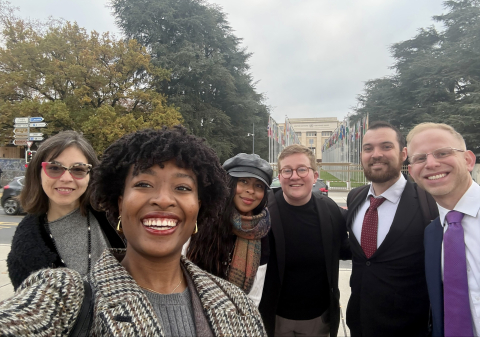
With the guidance of clinic director Jayne Huckerby, supervising attorney Aya Fujimura-Fanselow, and clinical fellow Jillian Rafferty, Duke Law International Human Rights Clinic students receive training in the practical application of international human rights law, alongside skills such as interviewing and documentation, to represent and support a range of actors on complex human rights issues.
“Across the United States and around the world, international human rights law is one part of the toolkit that stakeholders use to develop nuanced legal solutions to complex problems—whether that be for an existing protection gap or for an emerging human rights challenge,” says Huckerby.
Recently, for example, with U.N. Special Rapporteurs, students conducted interviews, consultations, research, and legal analysis to produce a briefing paper that was the first global report to comprehensively show how trafficking in persons intersects with the rights of persons with disabilities and what international human rights law requires stakeholders to do to address this problem. To amplify the impact of the findings, the paper was presented during a U.N. conference at its headquarters in New York.
As part of their fieldwork, students each semester travel to locations such as Geneva, Switzerland, where the U.N. Office of the High Commissioner for Human Rights is based. Recently, in Fall 2025, student teams in Geneva conducted fact-finding interviews with stakeholders, including U.N. experts, academics, and members of international non-governmental organizations, on clinic work related to trafficking in persons and other issues.
For Sam Andrus JD ’27, who developed an interest in human rights as an undergraduate, the Fall 2025 trip to Geneva was a heady experience. “It was incredible getting to go inside the U.N. buildings and the Office of the High Commissioner, going to interview stakeholders about things that we were researching and also getting to learn about career paths and how we could do that as well,” he said.
For former clinic student Diana Kenealy JD/LLM ’23 (recipient of the Duke Law Post-Graduate Fellowship in Public International Law and International Human Rights 2023-24) there is a throughline from the clinic work to her work in human rights after Law School. Kenealy’s experience in the clinic was pertinent in Phnom Penh, Cambodia, where as a Duke Law fellow she worked at a tribunal handling transitional justice issues following the prosecution of former Khmer Rouge leaders. There Kenealy found herself applying her clinical work on trafficking and armed conflict to understanding how best to pursue accountability for the forced labor imposed on the Cambodian people during Pol Pot’s regime. “I was thinking about trafficking patterns during the conflict and how they could have been accounted for in the work of the tribunal,” Kenealy recounted. “That was an interesting full circle moment.”


At left, Sam Andrus JD '27 and Clinic Director Jayne Huckerby review documents. Right, clinic students and staff gather for a farewell dinner in Geneva.
Successful clinic alumni, meaningful mentorship
These fieldwork experiences and the clinic more generally also provide students with opportunities for mentorship and networking with practitioners to support their efforts to establish careers in the field. In Geneva, among others, students met with clinic alumna Ely Cossio LLM ’19 (recipient, Duke Law Post-Graduate Fellowship in Public International Law and International Human Rights ’21-‘22) who is now a human rights officer at the U.N.
These meetings are consequential given that “the path into human rights law can be non-linear at times and can seem quite opaque from the outside,” according to Fujimura-Fanselow. Career support extends to IHRC faculty “continuing these conversations and supporting students over the course of their time at Duke Law.”
“The International Human Rights Clinic confirmed the career path I wanted to take as a human rights researcher and advocate,” says Rym Khadhraoui LLM ’17, a researcher and advisor at Amnesty International (and recipient of Duke Law Post-Graduate Fellowship in Public International Law and International Human Rights, 2018-19). “I believe my experience with the clinic and, more broadly, the international human rights law faculty and what I learned at Duke, was a great support and push for my career in the field.”
The clinic as part of Duke’s integrated and robust Human Rights Program
Many students enroll in the International Human Rights Clinic with a strong interest in the field. All students go on to integrate their experience in human rights into diverse careers, including as part of a pro bono practice in law firms and in government. But for those who want to make human rights itself a career, the route can sometimes be less clear.
The clinic and the broader Human Rights Program provide that clarity through additional programming and resources that the clinical faculty oversee, in particular through the Human Rights in Practice event series (and related career sessions) that features practitioners and academics from the United States and abroad and through the Human Rights Pro Bono Program. Duke also offers its Post-Graduate Fellowship in Public International Law and International Human Rights, financially supporting students as they launch their careers as human rights lawyers.
“You're doing research in the pro bono program that's actually going to help lawyers,” said Alexander Bindrim JD/LLM ’27, a project leader for the program. “It's the same kind of work that I'd be doing in the clinic, in a different setting.”
Those projects, alongside the skills he is learning and the substantive knowledge he is gaining in the clinic, have made the career Bindrim has long dreamed of now seem attainable.
“One of the reasons I wanted to go to Duke is the opportunity to do the kind of cutting-edge, high-level, interesting work that the clinic makes possible,” Bindrim said. “The clinic has redoubled my commitment to pursuing international human rights. Not only is it possible for you to make the connections that might one day enable you to do that kind of work, but you actually get to do it.”
