Wrongful Convictions Clinic: "We never, never, never give up"
The clinic teaches Duke Law students to pursue justice — even if it takes decades
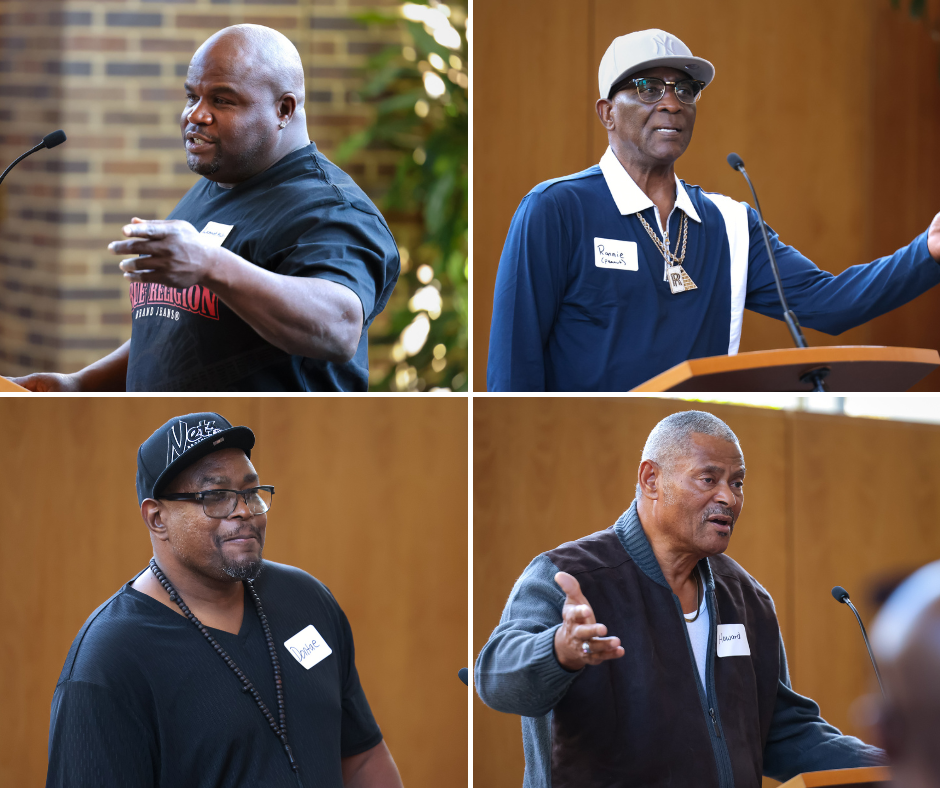
On a windy November day, half a dozen men joined students and faculty at Duke University’s Law School for a Thanksgiving meal. It was an afternoon of fellowship and gratitude, but each man had a unique and painful story of precious years stolen due to failures of the justice system.
- Ronnie Long was incarcerated in 1976 over a false rape conviction and was finally exonerated in 2020. “I couldn’t get justice in the state of North Carolina,” he said. “I filed motion after motion. They denied me every time.”
- Dontae Sharpe was imprisoned for 24 years — half his life — and even six years later he’s still constantly on guard. “I don’t sleep. I rest,” Sharpe said. “I get emotional and I cry about a lot of stuff. I’m exonerated but I don't think I’ll ever have true freedom.”
- Howard Dudley refused to take parole and plea deals for a sex crime he didn’t commit and endured two decades in prison by leaning on his faith. “Do your best,” he urged students. “I thank you for getting me out.”
- Lamont McKoy spent 27 years in prison for a murder he didn’t commit, refusing a plea deal that would have required him to admit guilt. While he’s free, he hasn’t gotten the full exoneration that would clear his name. “I’m still fighting,” McKoy said. “Every day it’s a struggle, but I just keep going.”
The men are now free thanks to the efforts of Duke Law’s Wrongful Convictions Clinic, which investigates and litigates claims of plausible innocence in North Carolina and has helped secure the full exonerations of eleven men and the release of five others.
More than 300 Duke Law students have worked on these cases since the clinic’s founding in 2008 by James E. Coleman, Jr., who directs the clinic, and Theresa Newman JD ’88, who retired in 2021 but is working to bring a long-running case to completion. Jamie Lau JD ’09 is the clinic’s supervising attorney. The clinic is assisted by student volunteers with the Duke Law Innocence Project, who screen requests for assistance and feed promising cases to the clinic.

Besides the 11 formal exonerations, student advocacy has freed others from prison, include Elroy Mitchell, who was granted parole after serving 30 years of a life sentence, and McKoy, who was released on parole but hasn’t yet had his conviction vacated despite strong evidence pointing to a different suspect. The clinic is fighting to clear the felony murder conviction from his record.
“Innocence is part of the reason they were able to ultimately obtain their freedom, despite having the conviction. We're confident in that,” Coleman said.
The clinic’s motto is “We never, never, never give up.” Coleman said students learn to persevere but must be realistic about what they can accomplish.
“I tell our students that we've got to be honest with our client,” he said. “We've got to let them know that we're going to do everything that we can possibly do, but it might not be enough so we have to prepare them for that. But we still have to make the effort.”


Above: Scenes from the Thanksgiving celebration hosted by the Duke Law Innocence Project
Lessons that shape a lifetime in law

Cases can go on for decades, and many clinic alumni, nicknamed “lifers,” continue working on them after they graduate or take on related pro bono work in their legal careers.
“Participating in the clinic was a really great exercise in being persistent and playing the long game, being thorough, and feeling like I can make a difference,” said Natasha DiFiore JD ’11, recalling long hours and holiday breaks spent on LaMonte Armstrong’s exoneration case, fueled by what she calls “the moral wrong” of imprisoning an innocent person.
The experience has guided aspects of DiFiore’s career trajectory, including leaving a law firm to serve as a public defender and weaving in other public interest work. Armstrong came to DiFiore’s wedding, and she and other members of his “A Team” attended his funeral after he died of cancer in 2019. So did Mike Matthews, the Greensboro police detective whose reexamination of decades-old physical evidence helped clinch Armstrong’s exoneration.
“Nothing has been more impactful in my career. It really puts into perspective what you can do as a lawyer,” DiFiore said. “Experiences like working with the clinic and getting to know clients like LaMonte gives you a sense of purpose. And I still feel that now. There’s a reason I did all that to be a part of his story.”
Eileen Ulate JD ’19, whose client Charles Ray Finch was exonerated two weeks after she graduated, joined the Department of Justice Civil Rights Division, where she addresses constitutional violations in prisons and jails.
“My time in the clinic not only taught me essential lawyering skills from investigations, writing briefs, and preparing for oral argument, but showed me how the law could transform lives,” Ulate said. “Most importantly, it taught me the power of hope.”
Michael Horowitz JD ’09, who also helped free Armstrong, went on to work another wrongful conviction case while in private practice.
“LaMonte was a special guy. There's no prouder day of my professional existence than being a part of a team that accomplished this,” Horowitz said. “But I'll be very honest: these cases are emotional roller coasters. They keep you up at night. Even when you’re brief writing, it’s like, ‘Have I missed something? Have I missed something?’ You lose sleep over it.”

Some, like Evan Glasner JD ’16, have focused their careers on wrongful convictions. Glasner and clinic partner Grady Champion JD ’16 were in court on the last day of an evidentiary hearing when the judge overturned their client’s conviction from the bench. Howard Dudley was exonerated and walked out of the courtroom that day.
“It was after 10 years of work, and I just happened to be in the right place at the right moment,” Glasner said. “That was certainly beyond my expectations for my clinic experience, and it was really formative.”
Glasner began a litigation career at a New York law firm after graduation but found more meaning working on pro bono Innocence Project cases. He returned to Duke Law as a clinic fellow in 2022 and in March 2024 saw the exoneration of Quincy Amerson. Glasner is now a senior staff attorney for the Midwest Innocence Project.
“For me, it’s important to feel fulfilled in my job,” Glasner said. “Criminal defense is very emotionally taxing. There are days when it's really difficult and — truthfully — depressing, but it’s also very rewarding. I like going to work every day. I'm invested in it, and I care about the clients and the result, and if I'm working late on a weekend I don't mind because I feel like I'm making a difference in someone's life.”
Shoshana Silverstein JD ’20 spent most of her third year of law school working with partner Nicole Wittstein JD ’20 on Ronnie Long’s petition for a full court rehearing in the Fourth Circuit. They were assigned to the case during winter break and spent the rest of the holiday getting up to speed.
“Nicole and I were going back and forth by phone in the airport and really hit the ground running once we got back,” Silverstein said. “We locked ourselves away in the clinic’s conference room and just sat there bouncing any ideas off each other, writing furiously, just talking through the issues. It was one of the most rewarding team experiences I’ve ever had.”
That summer Long was exonerated after 44 years of incarceration — one of the longest-serving exonerees in history. He was pardoned and received one of the largest civil settlements in North Carolina history. After graduating, Silverstein joined the Philadelphia District Attorney’s Office in its post-conviction review unit.
“I expected to go in as a traditional trial prosecutor but one thing that struck me over and over as we were working on Ronnie's case was how different this would have been if a prosecutor, at any stage in this case, had admitted that something had gone wrong,” Silverstein said. “I just kept thinking, ‘Why don’t I become the prosecutor I wish I had seen so many years ago in this case, who was willing to say a mistake was made and we need to fix it?’
“A prosecutor’s goal should be to do justice. Sometimes the just result is winning a conviction. Sometimes it’s not. I think reorienting our minds to understand that justice doesn’t always mean winning can go a long way in the prosecutor’s office.”
A new generation carrying the work forward

The work of the Wrongful Convictions Clinic has led to changes in North Carolina law and policy, but the influence of Coleman, Newman, and Lau goes well beyond the state.
“You can’t work on a case in the Fourth Circuit and not cite to a decision in one of the cases that those three worked on, because they’re the ones pushing the law forward,” Glasner said.
“I’m still trying to shoehorn their cases in my work now, even though I’m appealing to a different court. I’m very fortunate to have worked with them and they're definitely very, very well respected in the community.”
“I don't think I fully appreciated until I got out in the world just what an impact they’ve had, especially on the post-conviction legal landscape,” Silverstein said. “Duke is incredibly fortunate to have them because they are nationally renowned for their work.”
Coleman said that while most clinic students will go on to very different careers, part of his legacy is creating a community of lawyers who deeply understand the importance of always striving to improve the system.
“We do the work we do because we want the system to be better, and if we can make even a small contribution to that, we do it,” he said. “And part of the way I make a contribution is to try to instill it in my students, so that when they become lawyers it'll matter to them.”
Dan Richey JD ’16, who recently left the U.S. Navy JAG Corps and intends to pursue public defense, said his experience with Junior Chandler’s case made a deep impression on him and continues to impact the way he approaches his work.
Chandler, a former bus driver, was convicted in 1987 during the so-called “Satanic panic” scare when children brought now-discredited sexual abuse accusations against daycare workers and is one of the last defendants whose conviction hasn’t been overturned. Newman represented another defendant, Michael Alan Parker, in his 2014 exoneration on similar charges and is still working with Coleman to free Chandler.
“In terms of approaching cases, I thought back to that case and my experiences on it a lot,” Richey said. “As a prosecutor, you look at things that happened in that case and say, ‘I certainly never want that to happen.’ As a defense attorney, you think about how a lot of people, especially at the time of trial, looked at that case and just said, ‘Oh, he’s guilty.’
“When you drive up through the North Carolina mountains to this prison tucked away up there and you meet him and you realize this guy's been sitting there for more than 30 years, it really drives it home. You don’t want to have to look back and feel like any of your clients is in that position.”

